

When planning your estate, it’s important to understand how taxes may affect the transfer of your assets. While the federal estate tax receives much of the attention, several states also impose their own estate tax, often with exemption thresholds that are much lower than the current $15 million+ federal limit.
Understanding which states have an estate tax and how those laws work can help you make informed estate planning decisions. Whether you’re reviewing your current estate plan, relocating during retirement, or planning to pass wealth to the next generation, knowing the rules can help you avoid unexpected tax consequences.
Understanding How Estate Tax Works
An estate tax is a tax imposed on the value of a deceased person’s estate before assets are distributed to beneficiaries. The estate, rather than the beneficiaries, is responsible for paying any tax owed.
Whether an estate tax applies depends on several factors, including:
- The total value of the gross/taxable estate
- The state where the deceased was domiciled
- Whether the deceased owned property in states with an estate tax
- Federal and state exemption thresholds
It’s also important to distinguish estate tax from inheritance tax. An estate tax is paid/owed by the estate before assets are distributed, while an inheritance tax is paid/owed by the person receiving inherited assets. Most states impose neither tax, and only a few impose one or the other.
States That Currently Have an Estate Tax
Most states do not impose a state estate tax; however, Minnesota does. Here are the states (and the District of Columbia) that currently have an estate tax:
- Connecticut
- District of Columbia
- Hawaii
- Illinois
- Maine
- Maryland
- Massachusetts
- Minnesota
- New York
- Oregon
- Rhode Island
- Vermont
- Washington
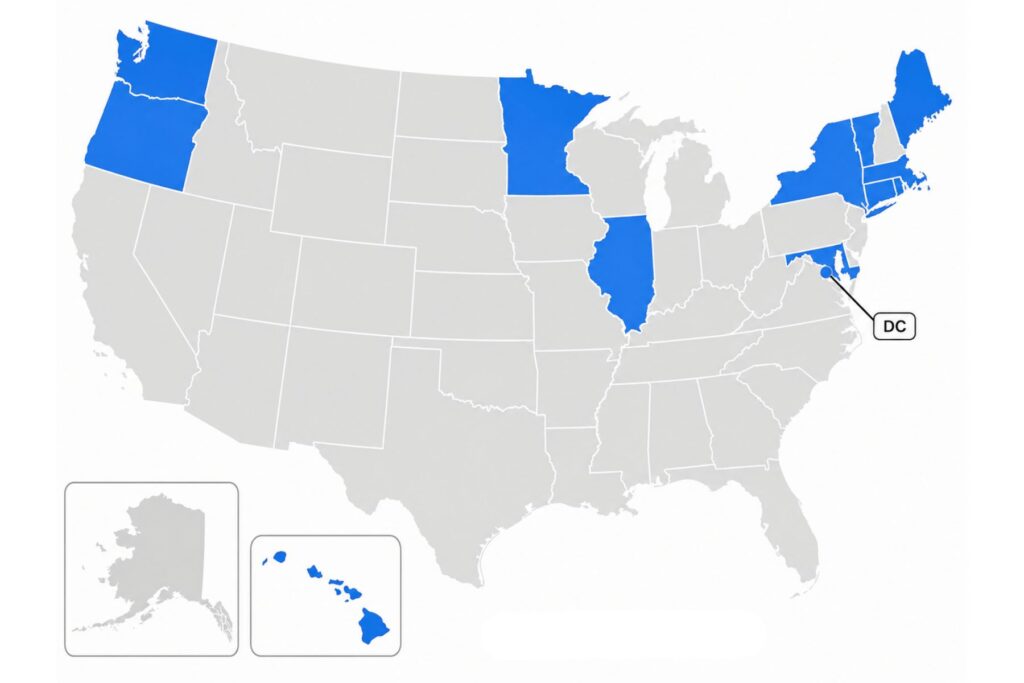
Each state establishes its own exemption amount, tax rates, and filing requirements. In many cases, the exemption threshold is significantly lower than the federal estate tax exemption, meaning an estate may owe state estate tax even if no federal estate tax is due.
Because state estate tax laws can change over time, it’s important to verify current rules when updating your estate plan.
States Without an Estate Tax
The majority of states do not impose a state estate tax. However, that doesn’t necessarily mean an estate will avoid all tax considerations. Depending on the circumstances, an estate or its beneficiaries may still be affected by:
- Federal estate tax if the estate exceeds the federal exemption amount
- Income tax or capital gains tax associated with certain inherited assets
- State estate/inheritance tax on assets held in other states
Planning Considerations for Families and Individuals
State estate tax laws deserve careful attention, particularly for individuals with significant assets or ties to multiple states.
You may want to review your estate plan if you:
- Own real estate in more than one state
- Plan to relocate during retirement
- Own a family business or other closely held assets
- Expect your estate to grow significantly over time
- Have not updated your estate plan in several years
Estate planning is not a one-time event. As tax laws, family circumstances, and financial goals change, your estate plan should evolve as well.
Working with experienced tax and financial advisors can help ensure your estate plan reflects current laws and supports your long-term objectives. At John A. Knutson & Co., we help individuals and families understand how changing tax laws may affect their estate plans and identify planning opportunities that can help preserve more of their legacy.
Staying Ahead of Changing Tax Laws
Although only a limited number of states impose an estate tax, the rules can be complex and are subject to change. State exemption amounts, tax rates, and filing requirements vary, making it important to understand how the laws apply to your specific situation.
Whether you’re updating your estate plan, preparing for retirement, or planning to transfer wealth to future generations, periodically reviewing your plan with a trusted tax advisor can help ensure it remains aligned with current tax laws and your long-term financial goals.
FAQs
-
As of today, Connecticut, Hawaii, Illinois, Maine, Maryland, Massachusetts, Minnesota, New York, Oregon, Rhode Island, Vermont, Washington, and the District of Columbia impose a state estate tax. Each jurisdiction sets its own exemption amount, tax rates, and filing requirements, so the impact varies considerably. Even if your estate is below the federal estate tax exemption, it could still be subject to state estate tax depending on where you live and the value of your estate.
-
States that impose an estate tax generally begin by determining the value of a person’s taxable estate, including assets such as real estate, investment accounts, business interests, and other property. After applying the state’s exemption amount, the remaining value is subject to the state’s estate tax rates. Because each state establishes its own exemptions and tax structure, the amount owed can vary significantly. Understanding your state’s rules is an important step in estimating potential estate tax liability and identifying planning opportunities.
For a simplified quick example: Generally in Minnesota, an individual estate is allowed a $3 million exemption to transfer to beneficiaries without being subject to the state’s estate tax; any amount over this is taxed between 13–16%.
-
Not necessarily. A state’s estate tax often depends on where the deceased was domiciled, but owning certain property, such as real estate, in another state may also create estate tax considerations. Individuals with vacation homes, rental properties, farmland, or business interests in multiple states may have more complex estate planning needs. Reviewing your estate with a qualified tax advisor can help determine whether multiple state tax laws could affect your estate.
-
An estate tax is paid/owed by the deceased person’s estate before assets are distributed to beneficiaries. An inheritance tax is paid/owed by the person receiving inherited assets. Most states impose neither tax, while a few impose one or the other. Maryland is currently the only state that imposes both a state estate tax and a state inheritance tax. Understanding the distinction can help families better prepare for potential tax obligations during estate administration.
-
Yes. The federal government imposes an estate tax, but it generally applies only to estates whose value exceeds the federal exemption amount in effect at the time of death, currently at $15 million as of 2026. Many estates will not owe federal estate tax, but some may still be subject to a state estate tax because several states have much lower exemption thresholds. Coordinating federal and state estate planning strategies can help reduce unexpected tax consequences and preserve more assets for your beneficiaries.